Contact Us! (805) 931-6787
Email Us!contact@usedcustomtacksaddles.com
EWork Hours
Monday to Friday: 7AM - 7PM
Weekend: 10AM - 5PM
Contact Us! (805) 931-6787
Email Us!contact@usedcustomtacksaddles.com
EWork Hours
Monday to Friday: 7AM - 7PM
Weekend: 10AM - 5PM
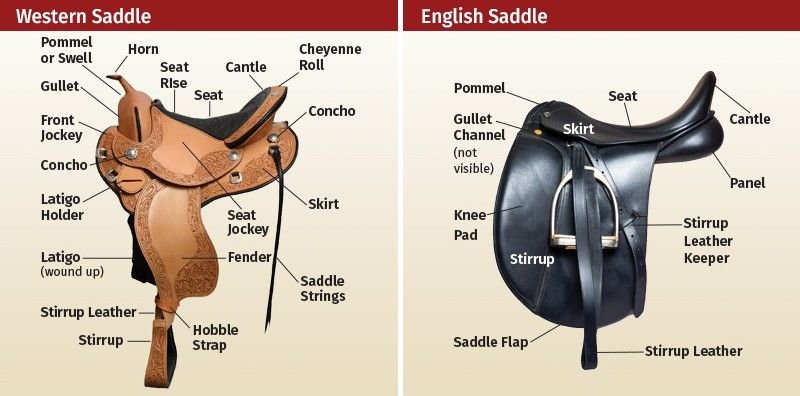
When it comes to choosing a saddle, the debate between Western and English styles goes far beyond mere aesthetics, horn sizes, or riding disciplines. At its core, saddle fitting is an exercise in physics and biomechanics.
The way these two types of saddles distribute weight across a horse’s back is fundamentally different. Understanding these mechanics isn’t just about rider comfort—it is absolutely crucial for preventing muscle soreness, white spots, and long-term spinal injury to your horse.
The most significant architectural difference between Western and English saddles is their “footprint” on the horse’s back.
A Western saddle is designed with a large, expansive surface area. Inside, the wooden or fiberglass tree features long, wide bars that run parallel to the horse’s spine.
By contrast, an English saddle has a much smaller, sleeker footprint. It completely lacks the extended bars of a Western saddle.
Because they sit on the horse differently, your checklist when checking the fit will vary depending on the gear you use.
| Fitting Criteria | Western Saddles | English Saddles |
| Primary Focus | Gullet clearance and the precise angle/flare of the bars. | Tree width, panel contact, and pommel-to-wither clearance. |
| Wither Clearance | Requires 2 to 3 fingers of clearance between the gullet and the withers. | Requires 3 to 4 fingers of clearance, ensuring freedom at the top and sides. |
| Stability | Must not rock forward and back or pinch the shoulders during movement. | Must balance perfectly level; panels must have even contact from front to back. |
⚠️ The “Tight Shoe” Effect: Because the contact points on an English saddle are so tight, the fit must be flawless. If an English tree is even slightly too narrow, it acts exactly like a pair of tight shoes—pinching the shoulder blades and severely restricting the horse’s natural stride.
Before buying or riding in either style, you must always check for bridging—one of the most common and damaging fitting errors in the equestrian world.
Bridging occurs when a saddle makes solid contact at the front (shoulders) and the back (cantle/bars), but leaves a hollow gap in the middle.
Why it’s dangerous: This creates severe pressure points at the front and back, completely bypassing the horse’s strong center support system. It quickly leads to kissing spine symptoms, muscle atrophy, and behavioral issues under saddle.